Science fiction used to have an advantage. We could invent something outrageous, give it a few flashing lights, put it fifty years into the future and nobody could tell us we were wrong.
Artificial intelligence? Fantasy. Self-driving cars? Maybe one day. A computer in your pocket connected to almost every piece of human knowledge ever recorded? Ridiculous. Private companies launching reusable rockets? Come off it.
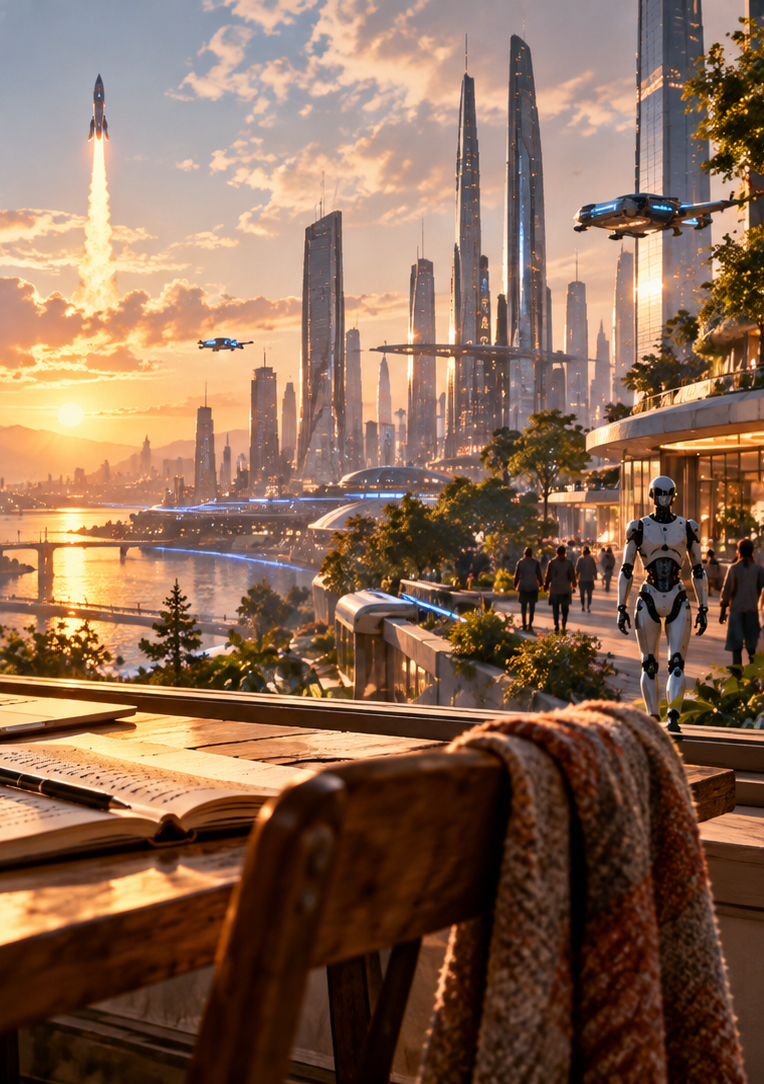
And yet here we are.
The problem for science fiction writers is that reality has started stealing our material. Not slowly either. It is becoming increasingly difficult to write about tomorrow without discovering that some lunatic engineer in California, China, Japan or a shed in Finland has already built the prototype.
That changes our definition of the job.
The old science fiction trick was to invent the technology and then show everyone how clever the future was going to be. These days, the technology is often the least interesting part because the reader has already seen something similar on YouTube, already working and often better designed.
The real question for now is what happens when AI becomes good enough that nobody knows whether they are talking to a human? When robots become cheap enough to do ordinary labour?
What happens when people live longer and we inhabit the first permanent settlement somewhere other than Earth?
What happens when one individual controls technology powerful enough to control governments? That's not a particularly wild question anymore because we are already approaching that milestone. I think this is where modern science fiction starts to become very interesting.
I have never been particularly fascinated by gadgets for their own sake. A shiny spaceship is nice. A laser weapon has its moments. Things exploding occasionally keeps everyone awake. But today technology is never scary until somebody has to live without it.
Give humanity faster-than-light travel and the interesting bit isn't the engine. It's what humans do when they get to their destination. Give us artificial intelligence and the interesting question isn't whether it can compose a poem. It's what happens when humanity becomes dependent on something more capable than itself.
Give humans immortality and within five minutes somebody will want to control it, and decide who gets to benefit from it.
That's humanity.
We have an extraordinary ability to turn miracles into problems. Science fiction has always been at its best when it understands that.
In stories, the aliens, spaceships and impossible machines are often only devices for asking very old questions.
Who gets power?
Who loses it?
Who decides?
Who benefits?
Who gets left behind?
And, fundamentally, what does an ordinary person do when the world changes beneath them?
That last point matters because history doesn't normally feel historic while you're living it.
People still need breakfast.
The washing machine breaks.
Somebody has forgotten to buy milk.
Meanwhile, outside the kitchen window, civilization is quietly changing direction.
AI alone has probably changed more about the way I use a computer in the last couple of years than the previous twenty years of upgrades managed between them. It sits beside me while I'm writing.
We argue. It occasionally gets things wrong and I occasionally get things wrong, and somewhere in that increasingly peculiar relationship is a version of a future that science fiction writers have been predicting for decades.
Except it doesn't feel futuristic. That's the trick reality plays, because the extraordinary becomes normal remarkably quickly.
The first time you speak naturally to a machine and it answers intelligently is astonishing. Six months later you're annoyed because it misunderstood the question. That transition from miracle to irritation may be one of the most human things we do.
So where does it leave science fiction when reality is already winning?